Content
Note: This report was written by the 2024-25 Executive Committee and originally presented to Madison Area DSA membership ahead of the March 2025 Chapter Convention. This public-facing version has been edited or abridged in some places.
Executive Committee
- Bonnie W, co-chair (she/her)
- Adithya P, co-chair (he/they)
- Jason M, administrator (he/him)
- Nathan J, treasurer (he/him)
- Halsey H, communications coordinator (she/her)
- Alex P, membership coordinator (he/him)
Introduction
The re-election of Donald Trump and the chaos of the first 100 days of his return to office have dominated the headlines and occupied the minds of our members lately. But as our annual convention meets in this uncertain and uneasy environment, our chapter should take time to reflect on all that we have accomplished since our convention last March.
This report is not intended to be an exhaustive account of everything our chapter and members have done in the past year. Rather, we intend to highlight critical achievements, pressing challenges, and new opportunities that will help guide future decision making. Every contribution made by our members, no matter how large or small, is crucial in building the organization and world that we need and deserve: one ordered on the flourishing of human potential, and not endless exploitation and accumulation.
What We Did This Year
Madison Area DSA is a membership organization, funded entirely by dues, optionally paid by our members directly to the chapter on a monthly basis, and from national DSA on a quarterly basis. Our numbers, our time, and our money are the resources we have to fight back against a rising fascist tide. Growing and maintaining our membership, therefore, is an organizational imperative. We are pleased to report that in this moment of national crisis, our chapter has attracted many new members, and reactivated lapsed members, who are motivated and ready to work in socialist organizing.
- Just this month, Madison Area DSA reached 440 members in good standing (MIGS). This set a new all-time high for the chapter and surpassed the previous membership peak in 2021. Since the November 2024 Presidential Election, we have added over 100 new members.
- Our chapter’s average meeting attendance over the last year was about 44 people, or 38 if only members are included. From April through October attendance was mostly in the 30-40 range, while post-presidential election there has been a large increase–about 80 in November, dipping to the 50s for December and January, and then over 90 in February. The February meeting is the largest known MADSA meeting ever!
- After moving from two chapter meetings each month to one in late 2023, this year the executive committee (Exec) decided to lengthen the monthly chapter meetings from 90 minutes to 2 hours. This was in response to both an increase in business (from regular chapter-wide deliberation over the School Meals priority campaign to political education to the fall election and DSA's response), and a sense that discussions were not being allowed enough time to build collective political analysis and understanding.
- In early March 2024, we endorsed the Wisconsin Uninstructed campaign to urge then-president Biden to stop the genocide in Gaza. In close collaboration with UW-Madison YDSA, we hosted four neighborhood canvasses and two campus tabling days, contributing to the 47,800 Uninstructed votes in the April primary election. This was a very fast moving, highly intensive campaign for organizers and volunteers.
- A number of YDSA and MADSA members attended or otherwise contributed to the UW-Madison Palestine encampment protest (aka Popular University for Gaza) that started at the end of April and lasted for almost two weeks. MADSA also endorsed and had different levels of organized involvement with several other solidarity actions over the course of the year: the War Profiteers Out of Madison rally in June (protesting a weapons manufacturing conference), the Not Another Bomb rally in August, and All Out for Lebanon in September.
- At the December chapter meeting following the election, members voted to organize within the local People's March as well as develop a People's Platform on which local elected officials could run. MADSA members played a large role in planning the local People's March which occurred on January 18th, and the chapter had a well-organized contingent present.
- One goal that Exec identified this year was providing more political education opportunities to members. While there is still work to do in this area (for example re-forming a political education committee/working group or similar), there has been fairly regular inclusion of political education programming in chapter meetings, and a reading group around Marx's Capital (Volume 1) started up in the fall. Other notable political education events for the year included hosting a talk by Professor August Nimtz in April, "Beyond Lesser Evils: Rethinking the Importance of Elections"; and the annual Socialism Conference in Chicago, which the chapter provided financial support for members to attend.
- This year, our chapter made the following electoral endorsements: DSA member Heidi Wegleitner for Dane County Board of Supervisors (uncontested, won), DSA member Francesca Hong for State Assembly (uncontested, won), DSA member Maia Pearson for state assembly (contested, did not win), and the 2024 Madison City and School November Budget Referendums (won). Out of all of these campaigns, we meaningly contributed volunteer time and energy to Maia Pearson’s campaign. Maia was running a slim campaign with only a few volunteers, and our chapter significantly expanded the communications and canvassing her campaign was able to do. Despite this, Maia did not win her race.
- We have a suite of Working Groups, Committees, and Campaigns, and this year they accomplished a lot, from helping new folks unionize their workplace to abolitionist political education to pressuring the school board for free school meals for all. For more information on what our chapter working groups and committees did this year, please see the other reports further down in this document.
Co-Chair Report and Reflections
Bonnie W, co-chair
Adithya P, co-chair
We have been proud to serve as your Madison Area DSA co-chairs for the past year. We have both served in multiple leadership roles in MADSA over the past several years (including as chapter admin and co-chair respectively in 2023-2024), and this informs our reflections shared below.
Background
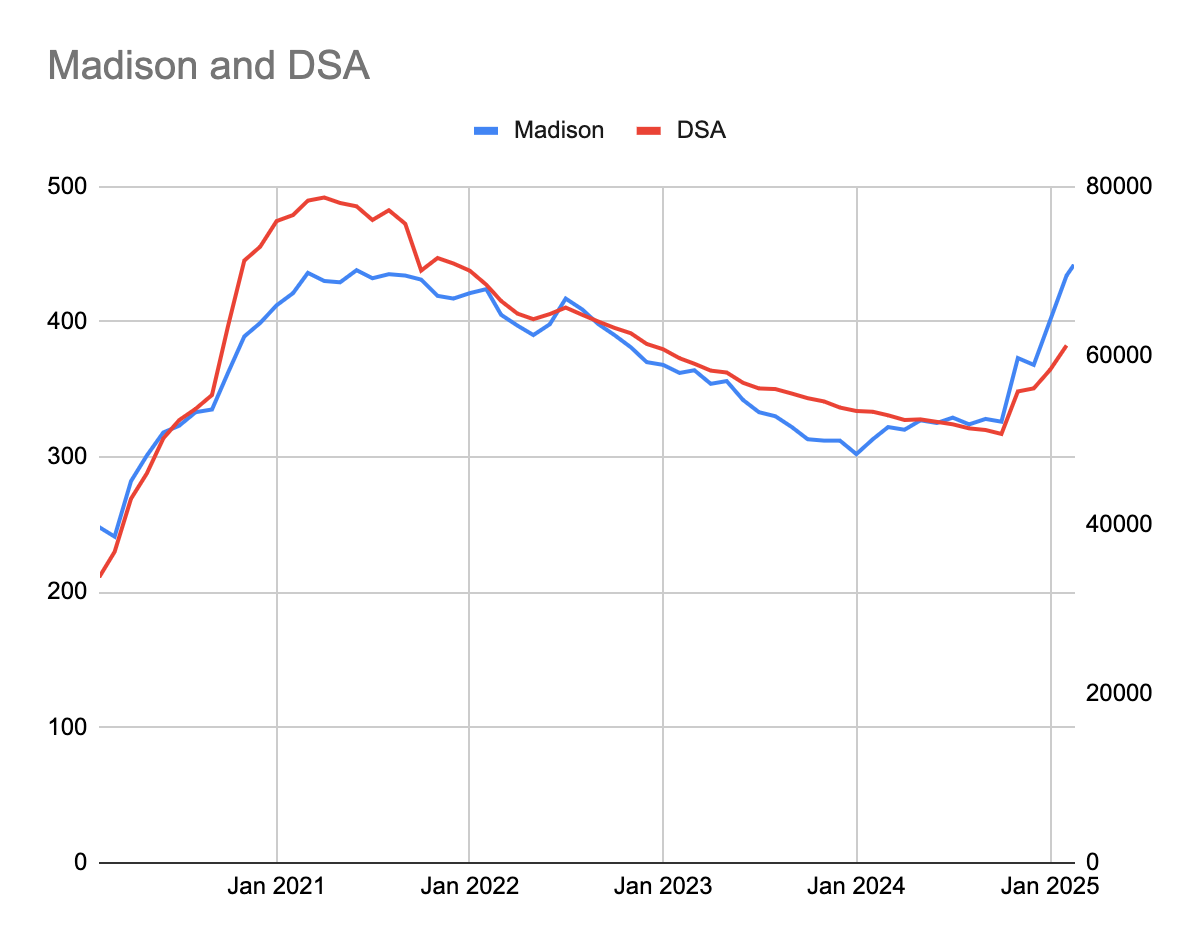
Although Madison Area DSA existed since the 80s, its modern era (like most other DSA chapters) began in late 2016 following the first Bernie Sanders presidential run, and the chapter grew quickly but unevenly in leaps and bounds over the next few years. From 2020 to 2021, in the context of the COVID crisis and racial justice uprisings, the chapter almost doubled in membership from around 240 to 440.
However along with the new members and radicalizing political landscape came internal challenges. All chapter activities moved to Zoom in 2020, which, over time, negatively impacted our ability to form relationships, work together, and resolve conflict. Chapter leaders also faced difficulties in trying to bridge the sometimes siloed, federated nature of our working groups. Efforts to set chapter priorities at previous conventions had mixed results, as most proposals were passed but lacked the focus and collective buy-in to be truly prioritized by the chapter.
These factors, in addition to a period of internal conflict in 2022 and the burnout and exodus of some former leaders disillusioned with DSA, initiated a slow decline in active membership and capacity in our chapter starting in 2022. This mirrored the membership trend in DSA nationally.
When we joined the executive committee for our first term in 2023, most of the chapter’s active leadership core had disengaged from the chapter, and most exec positions were filled by first-time leaders facing the difficult task of assuming the mantle of both administrative and political leadership. Despite these difficulties, the reduced activity also presented an opportunity to address MADSA’s long-standing issues with siloed working groups, lack of political cohesion, and leadership turnover.
Over the course of 2023, we helped make changes which helped to set the chapter on an upward growth trajectory by the end of the year. We began holding hybrid chapter meetings instead of Zoom-only and reduced meeting frequency from twice to once a month. We started hosting in-person chapter socials. We focused more on membership development at the chapter level and took advantage of support and training opportunities from DSA member-volunteers and staff.
Chapter leadership also made a substantial effort to rethink the 2024 MADSA Convention. We made the Convention a one-day in-person event instead of a two-day virtual event, as it had been for the previous 3 years. We did most voting in-person at the event, instead of virtually after the event, which was a significant shift in chapter culture and helped reestablish decision-making as a collective, participatory process rather than an individual, isolated task. Lastly, in order to refocus the chapter on a unifying strategic mission, we moved away from voting through a slate of chapter “priorities” in favor of voting through one priority campaign.
Politically, the year 2024-2025 was defined by the fight for Palestine and the election of Trump, sharpening the urgency of our organizing. For our chapter, it was a year of growth, campaign work, and renewed political clarity. Through it all, we made key interventions to build our chapter’s strength and impact—now, we take this moment to reflect on what we learned and where we go from here.
General Membership Meetings
Our goal was to increase attendance at general membership meetings and make them a central space for chapter-wide decision-making, discussion, and accountability. To achieve this, we committed to holding one chapter meeting per month, with a social afterward to encourage connection. We experimented with a second monthly meeting in late October but saw little additional engagement, so we stuck to the monthly model. Structurally, we aimed to include updates, political education, and discussion of ongoing campaigns in every meeting, though this wasn’t always feasible. A key shift was increasing the number of votes held at meetings—encouraging working groups and members to bring organizing proposals forward in a ready-to-vote format. This helped move decision-making out of smaller groups and into the general membership, creating a culture where members expected to participate in chapter-wide discussions and strategy. We also improved meeting promotion and divided up meeting roles more intentionally.
These efforts helped increase attendance, with average meeting participation rising from 19.6 in 2023 to 32.2 in 2024, even before the post-election surge. General meetings have become the lifeblood of the chapter, reversing the previous dynamic where working groups were the primary spaces for organizing. While newer members sometimes hesitated to speak or vote against proposals, participation remained high, and the shift toward more in-meeting decision-making helped integrate members into the chapter’s organizing process.
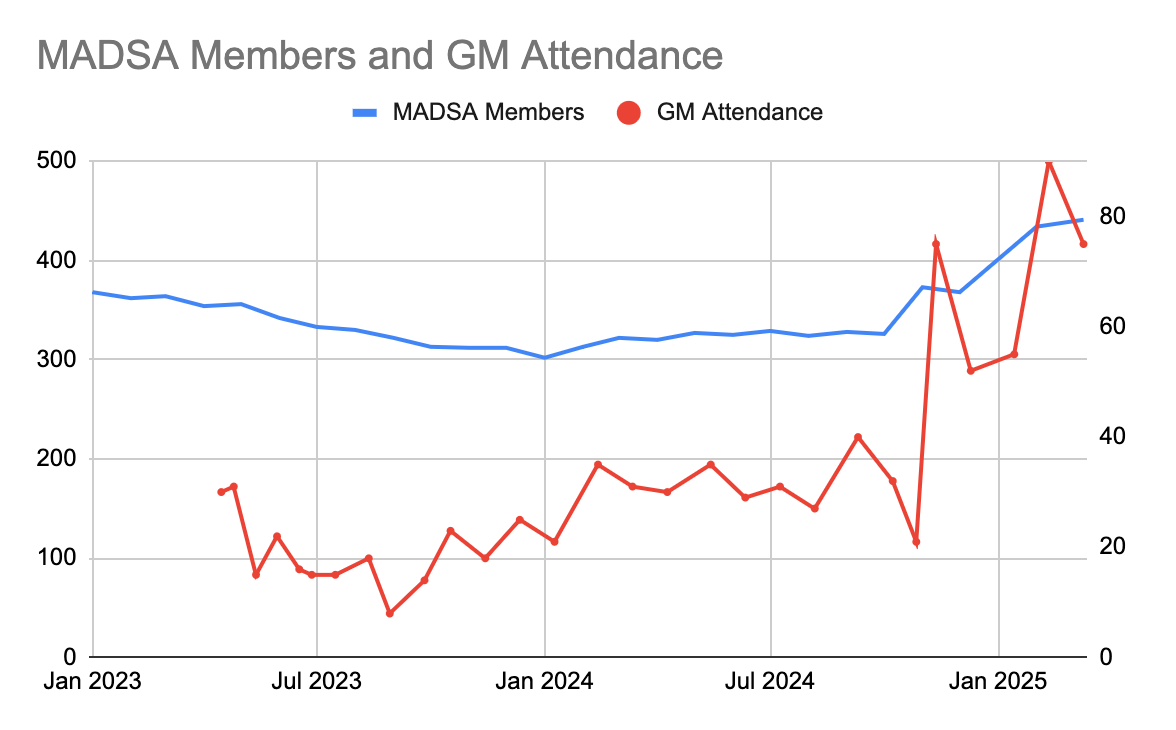
Note: Meeting attendance figures may not be 100% exact for some months.
Increased Transparency
To improve transparency of the executive committee, we made the #executive-committee Slack channel public, allowing members to see our discussions and deliberation. We also created and maintained documents explaining chapter resources and processes (like the chapter Quick Start guide, tutorials on how to use our texting platform, etc), making it easier for members to access important information. Additionally, we strove to share bi-monthly executive committee reports, which were shared via Slack and email to keep the chapter informed on exec votes, membership, the treasury, etc. Unfortunately, we failed to release a report between Oct. 2024 and March 2025.
Nevertheless, these efforts received positive feedback through word of mouth and our exec survey, showing that members felt positively about increased transparency. We recommend the next executive committee improve on this by making minutes of exec meetings more readily available to general membership and provide a record of decisions made by Exec in written or verbal reports at chapter meetings.
Commitment to External Work
We took on a number of large external-facing campaigns the past year, including the Uncommitted primary campaign in early March, the launch of the School Meals Campaign in April, support for the UW-Madison Palestine encampment in early May, the Maia Pearson State Assembly primary in June and July. School meals work continued through the fall and winter, interspersed with other initiatives like coordinating local Palestine solidarity rallies, the October endorsements of local budget referendums, and the People’s March in January.
As outlined elsewhere in this report, we saw major successes in some of these efforts. There was a collective sense of urgency to meet the political moment in 2024, as well as a shared desire among active membership to re-establish our presence locally after spending most of the previous year rebuilding the chapter. Madison DSA’s profile grew with increased media coverage and local visibility, and our increased presence was an important factor in our post-election membership growth and causing more people to see our chapter as a potential political home for them.
A recurring theme across many of the campaigns was that they often came together on short notice or with extremely aggressive timelines. Many also happened concurrently or immediately after other efforts concluded, and were bottomlined by a small group of the same chapter leaders who were juggling multiple projects and other leadership responsibilities. This resulted in an organizing environment where we deprioritized the crucial steps of debriefing and reflecting on work we had done in favor of taking on new work.
Chapter leaders had less time to devote to important questions of larger chapter strategy and political leadership, and spent less time communicating with other members and leaders and maintaining alignment on shared organizing goals. Falling into a rut of doing the work and losing touch with a guiding political vision is a prime recipe for burnout. Despite these shortcomings we see a lot of room for growth in the chapter this year, especially with many newer members looking to start new chapter work. We look forward to seeing new projects take shape and get developed collectively by membership.
One shortcoming of our priority campaign selection process at last convention was encouraging members to develop fully-formed campaign proposals before bringing them to chapter convention. The School Meals Campaign won majority support from membership both for David O’s strong vision, but also for the level of development and detail in the proposal. However, this led to some pitfalls when actually running the campaign, where despite David’s support other members struggled to build confidence and a sense of ownership organizing around the issue, and too often deferring on political and strategic questions to overburdened campaign leadership.
One lesson from this is that to build stronger leadership and buy-in, more members need to be involved in the process of developing strategies and vision for external campaigns, even if that means taking more time for campaigns to take shape and launch. More members taking ownership in this process is key to the further political development of the chapter.
Depoliticization
This reflected another chapter trend in 2024 – a depoliticization of the way we assessed our work internally and externally through an explicitly socialist lens.
While general membership weighed in on questions of strategy for ongoing work, these discussions sometimes de-emphasized the political dimension – not just considering what work to take on and why, but taking time to question and examine the ideological priors undergirding those strategies. This stemmed from a lower level of political development among active chapter membership and leadership compared to several years prior, and a lack of confidence applying a socialist analysis to our organizing methods and understanding of history.
For example, the school meals campaign’s original proposal invoked the legacy of the Black Panthers’ free breakfast programs. However the campaign and chapter never set aside time to learn and discuss the historical context those programs arose from, analyze how those conditions did or didn’t map onto our own, and reflect on what other lessons to take from previous generations of socialists.
Our attempts to place more emphasis on political education were haphazard, although we see significantly more chapter interest and opportunities to reprioritize this in the coming year. Developing members’ confidence in applying a socialist analysis informed by theory and history to their work is an important step to building a larger body of leaders and organizers in the chapter. While we made significant steps in building our organizing practice last year, we hope this year the chapter combines that with more engagement with socialist theory, further sharpening our practice.
Member and Leader Development
Our goal and continual challenge as a chapter was to re-engage membership by developing more members into active participants and future leaders. To do this, we made a number of changes to practices. Our February 2024 membership drive reinstitutionalized the practice of structured listwork of our membership; listwork being the practice of tracking outreach to and development of members. Listwork had not been done in the chapter in several years. This year, the practice was maintained in some working groups and campaigns. Exec also started doing listwork periodically to better track engagement and leadership development of active chapter members.
We also focused on delegating more entry-level tasks—such as setting up for meetings and processing sign-up sheets—to newer members, helping them build familiarity with chapter operations. Exec held two Leadership Roundtable retreats in June and December with working group and committee leaders to talk about membership development and strategize about collective work.
We had major success with revamping our monthly New Member Orientations (DSA 101s) and putting more emphasis on organizing new and prospective members to attend. Over the course of the past year, we made major overhauls to the presentation and our distribution of organizing labor around the events. In the fall we began regularly textbanking new and prospective members and had two members running the orientation, improving attendance to 5-8 people a month. This increased exponentially following the election, and we overhauled the format to meet the demand. Our November NMO had over 50 attendees, and we enlisted other chapter leaders to help facilitate breakout groups. Attendance remained above 30-40 in the last two months, and we began delegating more meeting roles to other newer members on the revived Membership Committee, which has yielded positive results. We intend to continue with this format going forward and encourage other chapter bodies to consider similar practices for delegating more responsibilities for meetings and events.
This year, we saw growing pains balancing continued internal membership engagement with a renewed focus on external-facing work. Our February 2024 membership drive helped develop many active members who took on larger leadership roles following the 2024 Convention on Exec, working groups, and the school meals campaign. We struggled to backfill their contributions on the membership committee, and a significant amount of membership work between the March convention and November election was performed by our membership coordinator Alex P and other members of the executive committee.
In the coming year, we recommend chapter leaders increase focus on membership development, such as the training series we held in February covering 1:1 organizing conversations and strategic campaign planning. Another area of emphasis for the chapter this year should be focusing more attention on leadership development and supporting current chapter leaders. Due to previous leadership turnover and loss of institutional memory, many new and existing leaders in the chapter did not receive as much support as needed to ensure they were in a position to succeed and help develop other leaders behind them. New and existing working group leaders were placed in difficult positions and some were unaware of all the resources and tools available to them through the chapter and national organization. This led to leaders being tasked with too many responsibilities and stretched thin.
Overcommitment also led to constantly planning and coordinating new actions and events, and we too frequently fell into the trap of core leaders taking on too many tasks themselves in order to meet tight deadlines. This came at the expense of opportunities to develop other members, creating a cycle where potential new leaders were less prepared to step up because they hadn’t gotten enough experience in lesser roles, because those were being done by existing leaders who were too busy to develop new leaders. One example of this was the YDSA-led People’s Org Fair the weekend after the election. Seeing the event planning well behind schedule, several members of the executive committee stepped in the week before the event and took on significant responsibilities planning panels and developing programming themselves, rather than working to identify other members who could be asked to take on these tasks.
Following our co-chair terms, we intend to help build more intentional leadership development opportunities in the chapter for both current and prospective leaders, and we hope to start breaking the cycle of leadership burnout and turnover that has plagued the chapter in previous years. We believe that with the influx of new members we have many potential new leaders who can develop and step into elected and middle leadership roles across the chapter in the coming year.
The Coming Year
As we look ahead, it’s clear that there is always more to do. In a time of rising fascism and ongoing attacks on workers' rights, the pressure to act is constant. But our mission is not just to act—it’s to act strategically. We must sharpen our socialist analysis to understand the political conditions of our city and country, using that understanding to choose fights that will build worker power and grow our capacity. A healthy chapter and a strong socialist movement require both external organizing—strategic campaigns, coalition building, and political education—and internal work to sustain ourselves, from leadership development to communications and membership outreach. Balancing these priorities is challenging, but we make small advances every day. To grow, we must also reflect, assess our choices, and improve through collective discussion and report-backs, and we encourage every working group, committee and campaign to make these a regular part of your organizing.
At the heart of it all, people stay in the fight because of each other—because of the relationships they build, the struggles they share, and the trust they develop. Strengthening the social fabric of our chapter is just as important as our organizing. We encourage everyone to plan and attend socials, talk to one another, talk to other chapters, and also build community connections beyond DSA. These relationships, particularly connections to DSA leaders across the country, have been central to our personal growth, which we’ve brought to the chapter and we encourage others to do the same.
As co-chairs, we’ve learned so much over the last year, and we’re energized by the growing number of people stepping into leadership and bringing new ideas. We welcome the diversity of political thought, debate, and even disagreement—because through these discussions, we sharpen our analysis and build a stronger movement. We encourage everyone to stay involved, step up, and help shape the future of our chapter!
Treasury Report
Some financial information has been redacted from the public-facing version of this report.
Nathan J, treasurer
- As our chapter grows, there is a greater need to accurately budget, which in turn requires tracking transactions in a ledger. Besides getting in the habit of budgeting and maintaining a ledger, a cash handling policy was adopted and a reimbursement request form (https://madison-dsa.org/resources/) was created to improve traceability of transactions.
- Balance: our chapter is financially stable and the balance of funds grew over the past year (April 2024 - March 2025). Budget details are included below, but here is a high level overview.
- Opportunities for growth: while it is nice to have a growing chapter balance, our chapter can afford to spend more money on outreach. Of our expenses, approximately 35% is for overhead expenses (rent, software, transaction fees, etc.), approximately 50% is for internal chapter development (meetings, conferences, food, etc.), and approximately 15% is for outreach (campaigning, tabling, public events, etc.). Overhead expenses and internal chapter development are necessary but should be viewed as serving the purpose of ultimately growing the chapter through outreach and making a difference in the community.
Membership Report
Alex P, membership coordinator
Adithya P, co-chair
-
Membership Numbers
- As mentioned above, Madison now has over 440 members in good standing as of 3/8/2025, our highest total ever. Members in good standing (MIGS) refer to members up to date on dues, granting them full voting and participation rights within DSA.
- This time last year, the chapter had about 325 MIGS. Counting constitutional members (members whose dues lapsed within the last year), MADSA has over 490 members today versus around 430 last March.
- Madison saw a net gain of 56 MIGS (from 312 to 368) over the 2024 calendar year, an 18% increase. Of the 50 largest DSA chapters, only 3 grew at a faster rate than Madison over the same time period. DSA membership nationally grew by 4% during this time.
- Madison saw a net gain of 108 MIGS (from 326 to 434) in the 4-month period between the election and the end of February, a 33% increase in membership. Of the 50 largest DSA chapters, only 4 grew at a faster rate than Madison over that period. DSA membership nationally grew by 21% during the same time span.
-
Membership Trends
- We saw a MASSIVE bump in membership following both the presidential election and inauguration. This rising trend will likely subside sometime in the next few months, but has not as of yet.
- As one might expect, interest in the chapter most often correlated with recent chapter activity in public spaces, be it tabling, protest participation while wearing/bearing DSA identifiers, or ongoing campaign actions. This has in part allowed us to maintain our numbers even in periods where National has seen slight membership declines.
- By far most new members coming to our chapter are ones who have self-selected joining (ie they found us, we did not find them). Going forward, it should be the goal of our membership strategy to utilize campaigns to make more direct asks of people to join our organization. Every action, big or small, is an opportunity to recruit.
-
Membership Committee
- Following the last convention, much of the existing membership committee participants were heavily involved in other leadership roles in the chapter. The formal organization of the committee went on hiatus during this time, but has since returned in early 2025. The committee is now meeting regularly (every other Wed.) and has been steadily growing in numbers.
- Much of the infrastructure for comprehensive membership outreach is already established, but will require more hands on deck to utilize. Further growth and development of committee members should be prioritized in the coming year.
- New Member Orientations have seen a complete re-work, moving towards a more interactive, discussion-centric model intended to allow us to learn about the myriad reasons new and returning members are seeking work in our chapter and organization.
- Active efforts have been taken to ensure that at least one chapter social event occurs every month, utilizing a more collaborative planning process that hopefully will see a greater variety of events being sponsored. Additionally, members have been empowered to reach out to others in the chapter more informally to organize smaller social gatherings to build more direct ties of solidarity.
- Following the last convention, much of the existing membership committee participants were heavily involved in other leadership roles in the chapter. The formal organization of the committee went on hiatus during this time, but has since returned in early 2025. The committee is now meeting regularly (every other Wed.) and has been steadily growing in numbers.
-
Other Work
- Chapter membership tracking and listwork has been significantly revamped, mostly to integrate automated member tracking and communications through ActionNetwork. Using this, we’ve been able to keep better tabs on what actions members are engaging in, how active they are with chapter events, and automating outreach to inactive and dues-lapsed members. Going forward we hope to see a greater degree of use and integration with ActionNetwork among other working groups and committees in the chapter.
Communications Report
Halsey H, comms coordinator
The big development in the last year is that we now have a communications committee that meets on a monthly basis. We’re starting to set up some roles and recurring tasks for different platforms, and we have a solid group of people who are doing some great graphic design, for social media and print propaganda materials. We have been posting regularly on our social media, and have a team of people working on making sure we have daily engagement, but there is definitely room for more people to get involved and support that work. Comrade Emerson M. has been making weekly posts across all of our platforms with all of the events coming up each week, and this has been very helpful for making sure we have more regular content and that members and prospective members have somewhere they can always check to see what’s going on. Our email newsletter has gone out roughly twice per month, and that and our other email communications have very good engagement.
Right now we’re working on creating some templates and how-to guides to get more people plugged in to comms work, to diversify the type of content we’re able to put out, and to make it easier for people throughout the chapter to get their events promoted. We’ve had a lot of success building the capacity of our comms committee, and I’m hoping we can continue to improve our ability to reach people in person and online in the coming year, and to post more photos and videos of all the cool stuff we have going on in the chapter – especially when we have members give presentations or speeches, because that content does really well.